
FMI.jl
What is FMI.jl?
FMI.jl is a free-to-use software library for the Julia programming language which integrates the Functional Mock-Up Interface (fmi-standard.org): load or create, parameterize, differentiate, linearize, simulate and plot FMUs seamlessly inside the Julia programming language!
| Documentation |   |
| Examples |  |
| Tests |    |
| FMI cross checks |  |
| Package evaluation |  |
| Code coverage |  |
| Collaboration |  |
| Formatting |  |
How can I use FMI.jl?
1. Open a Julia-REPL, switch to package mode using ], activate your preferred environment.
2. Install FMI.jl:
(@v1) pkg> add FMI3. If you want to check that everything works correctly, you can run the tests bundled with FMI.jl:
(@v1) pkg> test FMI4. Have a look inside the examples folder in the examples branch or the examples section of the documentation. All examples are available as Julia-Script (.jl), Jupyter-Notebook (.ipynb) and Markdown (.md).
How can I simulate a FMU and plot values?
using FMI, Plots

# load and instantiate a FMU
fmu = loadFMU(pathToFMU)

# simulate from t=0.0s until t=10.0s and record the FMU variable named "mass.s"
simData = simulate(fmu, (0.0, 10.0); recordValues=["mass.s"])

# plot it!
plot(simData)

# free memory
unloadFMU(myFMU)
What is currently supported in FMI.jl?
- importing the full FMI 2.0.3 and FMI 3.0.0 command set, including optional specials like
fmi2GetFMUstate,fmi2SetFMUstateandfmi2GetDirectionalDerivatives - parameterization, simulation & plotting of CS- and ME-FMUs
- event-handling for imported discontinuous ME-FMUs
| FMI2.0.3 | FMI3.0 | SSP1.0 | ||||
|---|---|---|---|---|---|---|
| Import | Export | Import | Export | Import | Export | |
| CS | ✔️✔️ | 🚧 | ✔️✔️ | 📅 | 📅 | 📅 |
| ME (continuous) | ✔️✔️ | ✔️✔️ | ✔️✔️ | 📅 | 📅 | 📅 |
| ME (discontinuous) | ✔️✔️ | ✔️✔️ | ✔️✔️ | 📅 | 📅 | 📅 |
| SE | 🚫 | 🚫 | 🚧 | 📅 | 🚫 | 🚫 |
| Explicit solvers | ✔️✔️ | ✔️✔️ | ✔️✔️ | 📅 | 📅 | 📅 |
| Implicit solvers (autodiff=false) | ✔️✔️ | ✔️✔️ | ✔️✔️ | 📅 | 📅 | 📅 |
| Implicit solvers (autodiff=true) | ✔️ | ✔️✔️ | ✔️ | 📅 | 📅 | 📅 |
| get/setFMUstate | ✔️✔️ | 📅 | ✔️✔️ | 📅 | 🚫 | 🚫 |
| getDirectionalDerivatives | ✔️✔️ | 📅 | ✔️✔️ | 📅 | 🚫 | 🚫 |
| getAdjointDerivatives | 🚫 | 🚫 | ✔️✔️ | 📅 | 🚫 | 🚫 |
| FMI Cross Checks | ✔️✔️ | 📅 | 📅 | 📅 | 🚫 | 🚫 |
| 64-bit binaries in FMUs | ✔️✔️ | ✔️✔️ | ✔️✔️ | 📅 | 🚫 | 🚫 |
| 32-bit binaries in FMUs | ✔️ | 📅 | 📅 | 📅 | 🚫 | 🚫 |
✔️✔️ supported & CI-tested
✔️ beta supported: implemented, but not CI-tested
🚧 work in progress
📅 planned
🚫 not supported by the corresponding FMI standard (not applicable)
❌ not planned
What FMI.jl-Library to use?
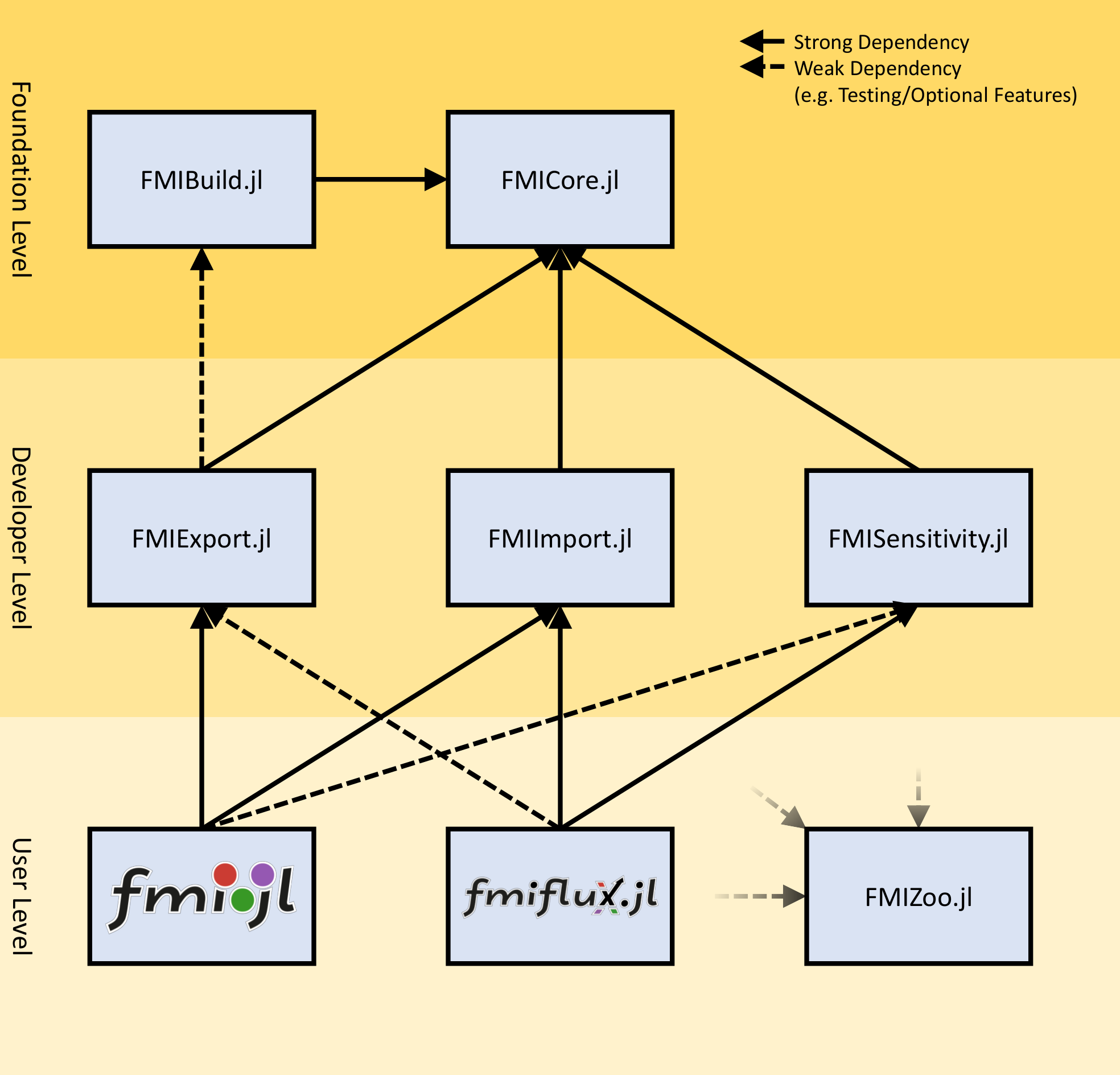 To keep dependencies nice and clean, the original package FMI.jl had been split into new packages:
- FMI.jl: High level loading, manipulating, saving or building entire FMUs from scratch
- FMIImport.jl: Importing FMUs into Julia
- FMIExport.jl: Exporting stand-alone FMUs from Julia Code
- FMIBase.jl: Common concepts for import and export of FMUs
- FMICore.jl: C-code wrapper for the FMI standard
- FMISensitivity.jl: Static and dynamic sensitivities over FMUs
- FMIBuild.jl: Compiler/Compilation dependencies for FMIExport.jl
- FMIFlux.jl: Machine Learning with FMUs
- FMIZoo.jl: A collection of testing and example FMUs
What Platforms are supported?
FMI.jl is tested (and testing) under Julia Versions LTS (64-bit) and latest (64-bit) on Windows latest (64-bit, 32-bit) and Ubuntu latest (64-bit). Mac (64-bit, 32-bit) and Ubuntu (32-bit) should work, but untested.
How to cite?
Tobias Thummerer, Lars Mikelsons and Josef Kircher. 2021. NeuralFMU: towards structural integration of FMUs into neural networks. Martin Sjölund, Lena Buffoni, Adrian Pop and Lennart Ochel (Ed.). Proceedings of 14th Modelica Conference 2021, Linköping, Sweden, September 20-24, 2021. Linköping University Electronic Press, Linköping (Linköping Electronic Conference Proceedings ; 181), 297-306. DOI: 10.3384/ecp21181297
Related publications?
Tobias Thummerer, Johannes Stoljar and Lars Mikelsons. 2022. NeuralFMU: presenting a workflow for integrating hybrid NeuralODEs into real-world applications. Electronics 11, 19, 3202. DOI: 10.3390/electronics11193202
Tobias Thummerer, Johannes Tintenherr, Lars Mikelsons. 2021 Hybrid modeling of the human cardiovascular system using NeuralFMUs Journal of Physics: Conference Series 2090, 1, 012155. DOI: 10.1088/1742-6596/2090/1/012155
Notes for contributors
Contributors are welcome. Before contributing, please read, understand and follow the Contributor's Guide on Collaborative Practices for Community Packages. During development of new implementations or optimizations on existing code, one will have to make design decisions that influence the library performance and usability. The following prioritization should be the basis for decision-making:
- #1 Compliance with standard: It is the highest priority to be compliant with the FMI standard (fmi-standard.org). Identifiers described in the standard must be used. Structures and topologies should follow the specification as far as the possibilities of the Julia programming language allows.
- #2 Performance: Because FMI.jl is a simulation tool, performance is very important. This applies to the efficient use of CPU and GPU, but also the conscientious use of RAM and disc space.
- #3 Usability: The library should be as usable as possible and feel "the Julia way" (e.g. by using multiple dispatch instead of the "C coding style"), as long as being fully compliant with the FMI standard.